One comment on two subjects.
I was always of the opinion that tipping was a thank you for good service and I confess that I may have been a bit impecunious in my gratuities. Then my daughter waited tables while at college, and I learned that these young folks are frequently paid only about half the minimum wage. I guess the theory is that generouos tips will make up the difference. I also learned that in its infinite wisdom, the IRS has determined that all food service employees receive full and benevolent tips all the time. And since the tips are obviously paid in large amounts of cash, the employees are told what amount to claim on their taxes whether they receive it or not. I don't know how one would figure what tips a person should have received over a year of waiting tables, but I am certain beyond doubt that the IRS has a very fair and equitable formula so that these wealthy waitresses and layabout busboys don't embark on a life of crime by defrauding the government of its fair share. I am much more generous now and I no longer consider over-tipping a mortal sin.
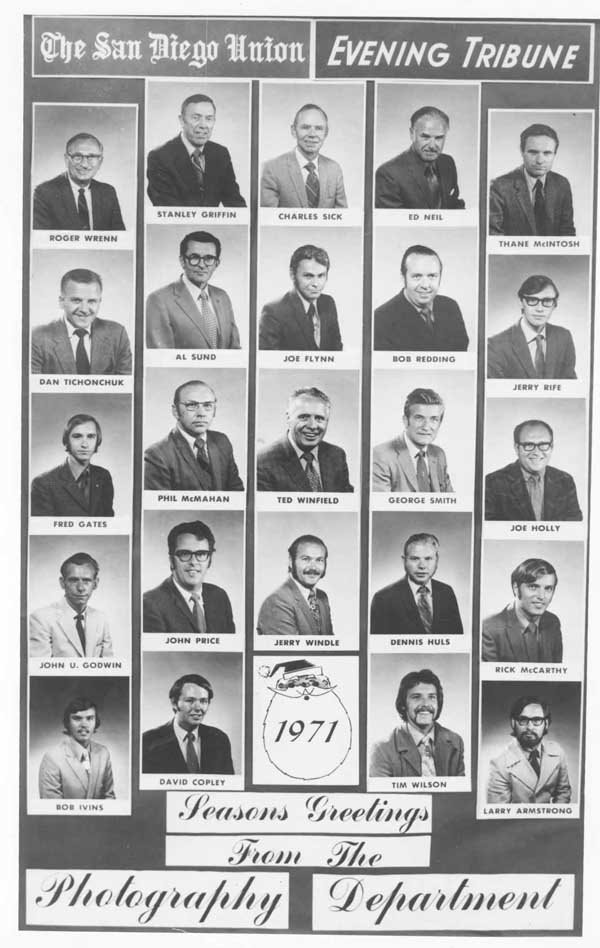
Like Jerry Remmers, I too embarked on a leisurely drive down Highway 1 in a 30-foot motor home; the one that Joe Holly and I shared. It was a lovely drive... for the first five miles. Then I found that herding a rolling motel around tight curve after tighter curve, flirting with spectacular drops into the ocean on one side and picturesque solid stone cliffs on the other, all the while leading a long parade of impatient Camaros and irate Porsches at 15 miles per hour across those narrow bridges was a lot of work! By the time we reached safe terrain, I was exhausted, and my arms felt six inches longer from pulling on the steering wheel. My wife was in a state of fear-induced catatonia and the only scenery either of us had seen the whole trip was when we would open our eyes to see how close the dropoff at the edge of the earth was coming to our wheels. The kids loved it and wanted to "do it again!"
Friday, January 11, 2008

Friday, December 21, 2007


I never did encounter “Trib” , the gorilla donated to the SD Zoo by Jim Copley, but I cuddled Alvila who at the time was a twenty pound black fuzzy baby. I was doing a story on the nursery at the zoo and it was feeding time. I don’t recall if I fed Alvila her bottle or just dandled her on my knee until time for her nap. I do know I did NOT change her diaper. That was 40 years ago. I saw a recent blurb for the zoo, and it featured my little buddy Alvila, a handsome figure to be sure, all 800 plus pounds of her. I imagine she can sleep anywhere she wants!
I also had the occasion to drop over to the Civic Theater to do a photo of Beverly Sills. I am not a fan of opera, I am too culture-deficient, but I had an absolutely pleasant photo session with her in her dressing room. She was a remarkably friendly and charming person, especially for a ‘big name’. I suppose that is why she was known as “Bubbles” Hers is the only photo of an opera personality that I bothered to keep. I would also put Charlton Heston and Carol Burnett in that class of biggies who seemed to be genuinely nice folks, which niceness was not just part of their public personna.
Monday, October 29, 2007
San Diego Fires
 Photo by John Gibbons, UT
 Photo by Charlie Neuman, UT
 For the past week, there have been devastating fires in San Diego. Over 500,000 people were evacuated and 1500 homes were destroyed. The 919 Gang was offline for a week as Jack Reber was unable to go to his home in Ramona. His, and all the others that I have heard of from the 919 gang, homes were safe. I sent him this message today:
I was very glad to see you came out of the fires relatively unscathed, Jack. I covered several of those nasty things for the UT and understand how devastating they can be. I happened to be in SD a couple of years ago when they tried to burn Tierra Santa etc, and got a good reminder of why they call them "wild fires" My wife's cousin lives south of Mission Valley and had houses all around him burn but the fire chose not to come up his canyon.
Is there anything that 'outsiders' can do to help? Perhaps a 919er or someone in Ramona you know of who needs ??? Or after things calm down a bit, there might be someone, older or widowed etc. There are a myriad little things that get forgotten in a disaster. I have had two brothers lose their homes to fires and I understand a bit about that. I suspect there are a lot of folks in this group who would be glad to help if they knew who or where or how.
My son Nathan and our Spanish exchange student Javier and I went to Hawaii several months after hurricane Iniki blasted through Kauai in 1992. It is the worst recorded storm in the islands and there were lots of folks who had no insurance or assistance and were living in temporary digs, even tents. Others had their roofs blown away and were living under huge blue tarps that covered their houses, while they tried to gather enough money to start repairs. We were able to join one of the work gangs for a week or so. The gangs were simply neighbors helping neighbors to start the re-building process when there was no more help coming from outside. We helped take off damaged roofs, tore an unsalvageable building down, helped clear the debris. It was not all hard work though. There were other neighbors who brought incredible Hawaiian food around for the crews! They were simply trying to give each other a little breathing room as they figured how to start their lives over.
Nathan, Javier and I also helped an old kamaaina Hawaiian named Tony Wong put a new roof on his house after his insurance company went bankrupt. Tony had gotten shingles somewhere but had no money to pay anyone to put them up. He was too old to climb the ladders or help shingle, but he easily made up for it by telling us non-stop stories about his life on the island while we worked. What a great experience for my son and me... and Tony's new red roof was the pride of Kekaha Road... even if the shingle lines are a bit wavy.
Email from Jerry Windle:
John,
You been gone longer than I but I kind of missed being in the thick of the wildfires this time around now that I are retired. Last time in 2003, I worked non-stop for several days. One lab tech was sick and the other had been evacuated so I worked 10-12 hour days. Even though I was not out there on the lines, I was in the newsroom downloading digital photos and placing them in the archive system and folders so the editors could easily find them. I enjoyed sitting there and listening to all the bickering going on behind me.
I never got into the politics of the newsroom. When they combined the papers in 1992, I got "reclassified" taking an $8,000 loss per year in income so I was bitter for several years and finally realized there was more to life than the UT so I went in did my job and that was it. Usually did a lot of personal work as well - that is once the company work was done.
Kind of like an old race horse, I wanted to be back in the fray of things again.
My reply:
Hey Jerry.... Yeah, I miss it. Its the old firehorse thing I suppose. I watched the fires on TV and found myself thinking... if I were on that little ridge right there, I could get SUCH a picture of that fire snake running up the other canyon!!! It was so much fun back then, how could we not get all nervous and twitchy? But I am also realistic. I would never want to go back, even if I could. I remember the politics and the stress... ok, spell that BS... and the long boring stuff with those three ladies and that stupid piece of paper... But the rest sure was fun wassnit?
Tuesday, October 16, 2007
Truth and Telephoto lenses


Ah, the dreaded Wide Angle Telephoto lens!!! How did I manage to forget that one? I recall many a cold winter evening, gathered about the pot bellied stove in the photo lab, the lively philosophical discussions as we delved into the mysteries of light and photography... images and editors. Truth and telephoto lenses. Who would not long for the day....
As I recall, it was Al Sund who stirred the congregation up over the Truth in Telephoto issue. The position that most of us took, picture editors included was: “the longer the lens, the more compression of the image.” Thus the editorial objection to Windle’s street scene taken with a telephoto lens and where all the signs and power poles looked as if they were so close they were rubbing together. The photo editor determined the telephoto lens had rendered Truth altered and the photo would not be appropriate to run. Al’s position remained that it was not the lens at all, but simply the position of the camera in relation to the subject. Further, it was not distorting the truth, but representing it exactly as it appeared. That is, Al contended, if you are a given distance from a given subject, the “ distance compression” will be exactly the same, regardless of the focal length of the lens you use to view it. He even went so far as to say that it would actually look the same to your eyes without any additional lens. The reaction was immediate and passionate... mine included.... “Friend Sund, thou speakest heresy I say, HERESY! Everyone knows it is the lens that compresses the apparent distance between objects! How about looking through binoculars? Huh? The lenses compress everything together. Any fool can see that.” At least we were right about the ‘fool’ part.
As a converted disciple of Al Sund, I went out and took these photos today. They are taken with a 28mm wide angle and a 210mm, mild telephoto from the same position. Yep, the compression and distortion in the telephoto is obvious. The train cars are in reality about 60 feet long and about 8 feet high, say an 8:1 ratio and they look like that... close to the camera... in the 28 mm photo. In the telephoto picture, the distant cars appear to be (quoting Pogo) squeened down and squeened together so that now they look shorter than they are tall, a less than 1:1 ratio. The billboards, which are really alongside the freeway, look like they overhang the train cars. And check out the impossible curve of the road. Yup, it is all distorted. And that nasty distortion, obviously because of that darned old telephoto lens, is what the photo editor objected to .
In the search for truth, I now offer the third picture... which is actually just a cropped and enlarged section of the 28mm photo. As you can see, when the objects are the same size in the photo, and still same distance from the lens, whether the wide angle or telephoto , they are virtually identical! Brothers and Sisters, we have found the elusive Wide Angle Telephoto!
Well, ok, the resolution, clarity, detail are obviously much worse in the 28mm pic when it is enlarged... soooo, does that make the wide angle shot the worse offender in the Truth Altered category? I can tell you that is how they appeared to my eyes but I wear glasses, so maybe I can't see what is truth?
At least, Al Sund was right about telephoto lenses.
Friday, October 12, 2007
I enjoyed Jerry Windle’s reprise of various camera memories from the old days. I never did carry a Yashicamat for the paper, although I did own one. I bought it from the AP staffer after I sold my own Rolleiflex to buy a sub-miniature Tessina from Stan Griffin. Several of the photogs had Rolleis at the time but then Stan bought the petite and delicate Mamiyaflex as the camera du jour for the whole staff!!! That was a twin lens monster! They were bigger and heavier than a Remington standard typewriter and had interchangeable lenses the size of two sewer pipes. They did make good negatives though.
I used my shiny new Mamiyaflex C33 the time I was assigned to shoot Governor Reagan (in the photographic sense) when he was running for president. The Copley power structure had made arrangements for me to ease past all the security and get an exclusive photo at the event. The press corps was sequestered on a little patio outside someone’s La Jolla mansion and were told there would be no photos!. When the moment arrived, I was whisked into a parlor where Regan and a couple of the Republican faithful, one was a judge as I recall, were to pose exclusively for me... well, OK... for the Copley Press. I lined everyone up in a ‘natural’ pose and prepared to take the photos. I was convinced that each would undoubtedly be worthy of the Pullet Surprise. I pushed on the shutter... and nothing happened! That will get your attention! “OK, once more now....” Nothing! The shutter lever on my new camera would not move and I could not take the picture. By the third effort, I was developing a serious aneurism and the Governor cum President was getting more than a bit peeved as he stood with his best campaign smile pasted on, glaring at me and waiting! Panic was infusing my fevered brain when I noticed the safety-interlock lever on the side of the camera. It was a little knob that prevented the film from being exposed while the lenses were off. It also locked the shutter when engaged and it was doing its job admirably on this occasion! I don’t recall ever hearing such a sweet sound as when that shutter clunked the way it was supposed to. I got a magnificent photo of the three dignitaries and slunk off into the night to nurse my seriously battered ego.
Another time I used Phil McMahan’s Leica. Now THAT was a camera you could learn to love. I recall that Beverly Beyette was doing an investigative piece that turned into a series on nursing homes for the elderly. Beverly was pretending to be looking for a home for her aged mother and I was her ne’er do well brother, I think. I was supposed to get photos without anyone knowing what we were doing. I know this sounds like it came right out of an old James Cagney movie “The Picture Snatcher” , but I borrowed Phil’s Leica, hung it around my neck under my shirt with just the lens sticking out between the buttons. I could then move my ultra-wide, psychedelic tie aside (remember those?) and take pictures. The plan worked. Beverly would talk to the nursing home person about taking care of dear old Mother, to keep them busy, and I would try to wander aimlessly off to get the photos. The Leica was compact and so quiet you couldn’t hear the shutter if you were standing next to me. I took several by just turning away from the person. We got dramatic photos of conditions inside some pretty nasty “care” facilities. The paper ran the series and later, Copley Press published it in a booklet. As I recall, there was a major shakeup in the requirements and oversight of California care facilities as a result.
I used my shiny new Mamiyaflex C33 the time I was assigned to shoot Governor Reagan (in the photographic sense) when he was running for president. The Copley power structure had made arrangements for me to ease past all the security and get an exclusive photo at the event. The press corps was sequestered on a little patio outside someone’s La Jolla mansion and were told there would be no photos!. When the moment arrived, I was whisked into a parlor where Regan and a couple of the Republican faithful, one was a judge as I recall, were to pose exclusively for me... well, OK... for the Copley Press. I lined everyone up in a ‘natural’ pose and prepared to take the photos. I was convinced that each would undoubtedly be worthy of the Pullet Surprise. I pushed on the shutter... and nothing happened! That will get your attention! “OK, once more now....” Nothing! The shutter lever on my new camera would not move and I could not take the picture. By the third effort, I was developing a serious aneurism and the Governor cum President was getting more than a bit peeved as he stood with his best campaign smile pasted on, glaring at me and waiting! Panic was infusing my fevered brain when I noticed the safety-interlock lever on the side of the camera. It was a little knob that prevented the film from being exposed while the lenses were off. It also locked the shutter when engaged and it was doing its job admirably on this occasion! I don’t recall ever hearing such a sweet sound as when that shutter clunked the way it was supposed to. I got a magnificent photo of the three dignitaries and slunk off into the night to nurse my seriously battered ego.
Another time I used Phil McMahan’s Leica. Now THAT was a camera you could learn to love. I recall that Beverly Beyette was doing an investigative piece that turned into a series on nursing homes for the elderly. Beverly was pretending to be looking for a home for her aged mother and I was her ne’er do well brother, I think. I was supposed to get photos without anyone knowing what we were doing. I know this sounds like it came right out of an old James Cagney movie “The Picture Snatcher” , but I borrowed Phil’s Leica, hung it around my neck under my shirt with just the lens sticking out between the buttons. I could then move my ultra-wide, psychedelic tie aside (remember those?) and take pictures. The plan worked. Beverly would talk to the nursing home person about taking care of dear old Mother, to keep them busy, and I would try to wander aimlessly off to get the photos. The Leica was compact and so quiet you couldn’t hear the shutter if you were standing next to me. I took several by just turning away from the person. We got dramatic photos of conditions inside some pretty nasty “care” facilities. The paper ran the series and later, Copley Press published it in a booklet. As I recall, there was a major shakeup in the requirements and oversight of California care facilities as a result.
Friday, September 14, 2007
JOE STONE, REPORTER

I have always liked this picture. It is of Joe Stone, a metro reporter on assignment, as he thoughtfully writes down his impressions of the spring wildflower bloom out on the desert of Borrego Springs. Thats the kind of story some crusty reporters would consider beneath them. Joe was a good newsman and I think this photo proves it. Joe's brother was Milburne Stone who played Doc for many years on the classic tv series Gunsmoke.
Wednesday, September 5, 2007
U-T HELICOPTER 09NOVEMBER
 Photo taken from the UT helicopter 09N. I loved flying in that bird with a crusty pilot named, of course, Pappy. You can see the door is off and one of the blurred rotors in the sky and my knee, bottom center.
BETTY PEACH-TSCHIRGI writes:
You mentioned a need for fresh subjects from the 919 Gang. This may have been covered previously, but I do not recall reading memories of the Copley Chopper that was parked at Lindbergh Field, and was on call for the Tribune city desk. The helicopter could be at the paper's pad in less than 10 minutes.
The landing pad was reached via the lunch room and big open deck added above the Tribune's annex building, if memory serves.
It was always such fun to get to the pad in time to watch the noisy beast approach from the direction of the Grant Hotel diagonally across the Land Title Building, and hover inches above the pad. A photographer and I waited at the foot of a half dozen stairs until the helicopter door opened, our signal to dash up the steps, crouching low to keep the head out of the path of whirling blades.
Liftoff was immediate, the nose tipping forward to pick up speed. the sensation of diving into the pavement was a shot of adrenaline every time. The pilot must have startled people on the street, for he didn't level off until the last second.
When we had a small machine, I always sat in the middle so the photographer had the window seat. Sometimes the door was removed to give the photog wider view. Sturdy seat belts recommended.
One assignment I remember especially because of its rarity: unusually heavy rains had flooded all the streams in the county and had washed out the approaches of the Santa Fe railroad bridge south of Oceanside.
The adjacent highway bridge floor was under water, so it was closed on both ends.
San Diego was essentially cut off from the rest of the world ... no rail, no road ... ah, but the wonderful helicopter came to the rescue. We left the office about 9 a.m., flew directly to the target flood, and returned to 919 Second Ave., in time to have photos splashed all over page 1 of the home edition.
All hail the power of the whirlybird!
My comments added:
Thanks Betty for jogging those helicopter memories. I loved flying in it too. It was an early Bell helicopter, the kind with an open tail boom and a huge plexiglas fishbowl bubble to sit in up front. You REALLY got the sensation of flying. I remember its radio call sign was Zero-Nine-November... niner, if you wanted to be really cool. I remember the pilot was a crusty old aviator called Pappy, what else? I never did know his last name and can't imagine why I would I want to. My favorite part was also the take off from the UT roof pad. Pappy would lift it up enough to clear the railing on the pad, then tip forward and swoop out over Second Ave, past the unforgiving building that towered above us on the right...was that the Spreckles Bldg?, and skim the parking lot and the UT garage on the corner to the left as he climbed. He seemed to think it desirable to get above all the buildings and power lines that surrounded 919.
What a lovely way to travel!
And Betty, I well remember that you always took the center seat so the photog could ride shotgun. I know that was a sacrifice, since you are a pilot yourself, and I always thought it was a class thing for you to do.
Subscribe to:
Posts (Atom)