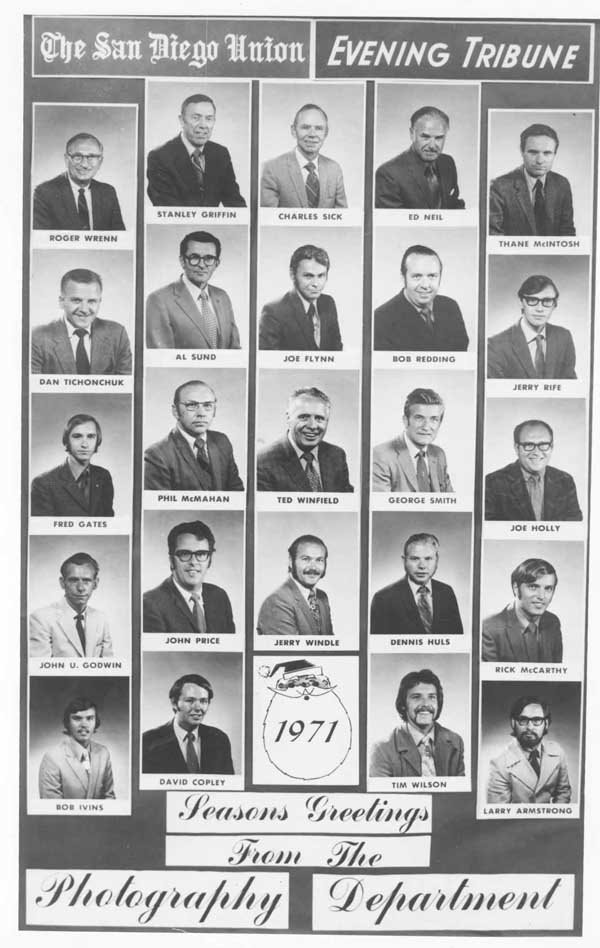
JERRY WINDLE writes:
MORE BAD NEWS FOR NEWSPAPERS: "In just the past few weeks, The San Diego Union-Tribune eliminated more than 100 jobs, one-tenth of its work force. The Chicago Sun-Times began a round of deep newsroom layoffs, then put itself up for sale, and publishers in Minneapolis and Philadelphia warned that tough economics could force cuts there."
JR: The article is from the International Herald-Tribune, and it talks about the problem of shrinking ad revenue and dwindling subscriptions as an industry-wide problem. The story says combined print and online advertising dropped 7 percent last year. Of course, for printed papers, the drop was even worse.
PETER KOELEMAN writes:
Echoing the article Jerry Windle saw in the NY Times, we just lost 90 percent of our photo production staff (seven jobs). Our paper is going to automate the process with software called Intellitune. Not the same quality results but cutting payrolls and expenses is apparently a bigger priority than quality. Not a good time for newspapers. The Star Tribune has lost $75 million in revenue over just two years and the downward curve isn't straightening out.
JR: Peter is Director of Photography at the Minneapolis Star Tribune.
TOM STINSON writes:
Jerry Windle mentioned that the U-T has eliminated one tenth of its workforce. That's probably true, but some departments have been hit much harder. Four or five years ago the Library had sixteen employees. Now it's down to six. In December the Library still had nine employees. Since then three have been cut, including yours truly. My math isn't too good, but that's a lot more than ten percent. The Library is now having difficulty performing some if its basic functions. Does anybody care?
JR: I suspect everyone in this group cares, Tom, and I know I was stunned to hear you were let go. Hope you've hooked on somewhere else. Keep us informed.
Note: All this downsizing came long after I left the paper. Even at the time I was there, television was becoming the obvious news medium of choice into the future. And that has pretty much come to pass. TV will never be able to provide the same kind of gritty, close to the gut news that newspapers were absolutely made for and that is a sad loss. I am not ready to pronounce a eulogy for print, but I think to a great extent, the patient as we know it, is already terminal.
Monday, February 11, 2008

ADVICE TO THE WORLD
ELSON IRWIN writes:
What I would tell the world would be what my father told me on his deathbed when I was just eleven years old. He knew, of course, that I was a great western movie fan, so he said to me, "Elson, always ride the white horse." It didn't take a nuclear scientist to understand that bit of advice.
In the majority of the old western films, the "good guy" rode the white horse: Buck Jones, Hopalong Cassidy, the Lone Ranger, Bob Steele, Charles Starrett, Ken Maynard. (Several didn't such as Gene Autry and that Roy feller, but then, they weren't real cowboys.) The super "good" guys rode white horses and wore white hats. There was a certain significance in that. The bad guys wore black hats and had black mustaches. To this very day, it is difficult for me to trust anyone who has a black mustache. So, the immortal words are: "Ride the White Horse." I have tried to live by that credo. I have not always succeeded, but it's kept me out of jail.
I would like to have etched on my tombstone: "He rode the white horse."
JR: Elson is responding to Joe Holly's question "If you had the opportunity to tell the world one thing, what would that one thing be?" I like Elson's answer because it is only five words, yet it carries so much meaning.
What I would tell the world would be what my father told me on his deathbed when I was just eleven years old. He knew, of course, that I was a great western movie fan, so he said to me, "Elson, always ride the white horse." It didn't take a nuclear scientist to understand that bit of advice.
In the majority of the old western films, the "good guy" rode the white horse: Buck Jones, Hopalong Cassidy, the Lone Ranger, Bob Steele, Charles Starrett, Ken Maynard. (Several didn't such as Gene Autry and that Roy feller, but then, they weren't real cowboys.) The super "good" guys rode white horses and wore white hats. There was a certain significance in that. The bad guys wore black hats and had black mustaches. To this very day, it is difficult for me to trust anyone who has a black mustache. So, the immortal words are: "Ride the White Horse." I have tried to live by that credo. I have not always succeeded, but it's kept me out of jail.
I would like to have etched on my tombstone: "He rode the white horse."
JR: Elson is responding to Joe Holly's question "If you had the opportunity to tell the world one thing, what would that one thing be?" I like Elson's answer because it is only five words, yet it carries so much meaning.
THE TIES THAT BIND


JERRY RIFE writes:
In the '60s and '70s, a quick glance at the UT staff would have given the impression that we were all cut from the same bolt of cloth. Perhaps more than anything, that impression was conveyed by a simple strip of clothing, the necktie.
Every man wore one. (And since there were few women in the newsroom, that meant nearly every person) Photographers, whether shooting a bloody corpse or a society matron, would not have been caught dead without a tie neatly tied.
At first, the neckties were dark and subdued. They gave an air of gravitas while being able to hide a gravy stain. As the decade rolled on, newsroom ties exploded in a riot of color and design. They blossomed like flowers in springtime.
But it is the nature of flowers to wither and die. So too was the tie to fall from our collective neck like some pooped pansy.
When this picture was taken in September of 1981, autumn had already arrived for the UT necktie. Like the last rose of summer, a tie-adorned Charlie Sick was faced with a changing climate. The open-collared ruffians are (l-r, in back) Don Bartletti, Barry Fitzsimmons, Phil McMahan, Joe Holly, Jerry Rife, John Gibbins and George Smith.
I forget the name of the guy fingering Charlie's tie.
But I remember so well the time when the tie died.
Note: I well remember both the ties and the outrageous "psychedelic" colors and patterns of the 70's. Sally used to find the most ridiculous material and then hand make mine, about six inches wide, pink, orange, flourescent purple... and glow-in-the-dark would have been at the top of the wish list.
SECURITY, SECURITY, SECURITY
BILL OSBORNE writes:
Here's a potential new thread: U-T security guards. These are almost invariably good people who work hard and do what they can to uphold the best interests of the company. Over the years many of them become members of the club of people we see every day and people we miss when suddenly we don't see them anymore, regretting that we did not make a greater effort to engage them. Still, there are some great stories about our security people.
Here's one of them: Back in the early or mid-1970s, during the days of the Arab oil embargo and odd-even gasoline rationing, there was a reporter at the Tribune named Bob Dorn, an iconoclastic fellow whose name has come up a couple times before in the 919 newsletter. Bob and I rented the Cardiff home of Union financial writer Wayne Carpenter while he was sailing around the world with his family, but we could not carpool to work during the gas crisis because of significantly different schedules. Bob drove an ugly yellow Fiat with windows that were forever coated with the slobber of his mangy but lovable dog, Sumo. One day at work, Bob discovered that his Fiat was out of gas in the parking lot. The car next to his belonged to fellow Trib reporter Barbara Herrera, so Bob asked Barbara if he could siphon a gallon or so of gas from her car to get him going. She agreed and Bob started doing his siphon thing. As Bob told the story, the next thing he knew there was a U-T security guard behind him, gun drawn, demanding that he halt the gas thievery. Bob, who on any given day could easily pass for a gas thief, talked fast and all ended well, with no casualties. But Bob spent the rest of the day calculating the odds of whether that security guard was the one who carried the bullet that day.
Here's a potential new thread: U-T security guards. These are almost invariably good people who work hard and do what they can to uphold the best interests of the company. Over the years many of them become members of the club of people we see every day and people we miss when suddenly we don't see them anymore, regretting that we did not make a greater effort to engage them. Still, there are some great stories about our security people.
Here's one of them: Back in the early or mid-1970s, during the days of the Arab oil embargo and odd-even gasoline rationing, there was a reporter at the Tribune named Bob Dorn, an iconoclastic fellow whose name has come up a couple times before in the 919 newsletter. Bob and I rented the Cardiff home of Union financial writer Wayne Carpenter while he was sailing around the world with his family, but we could not carpool to work during the gas crisis because of significantly different schedules. Bob drove an ugly yellow Fiat with windows that were forever coated with the slobber of his mangy but lovable dog, Sumo. One day at work, Bob discovered that his Fiat was out of gas in the parking lot. The car next to his belonged to fellow Trib reporter Barbara Herrera, so Bob asked Barbara if he could siphon a gallon or so of gas from her car to get him going. She agreed and Bob started doing his siphon thing. As Bob told the story, the next thing he knew there was a U-T security guard behind him, gun drawn, demanding that he halt the gas thievery. Bob, who on any given day could easily pass for a gas thief, talked fast and all ended well, with no casualties. But Bob spent the rest of the day calculating the odds of whether that security guard was the one who carried the bullet that day.
Were you really a newspaper man, Grandpa?
JOHN PRICE writes:
This is John Price on my Yahoo address on the road. I can't access my regular email. I am on a business trip to Florida. I know, so sad that I had to leave the snow and sub-zero weather of Idaho for global warming or whatever you have to suffer through here in Florida in the winter, but such is the call of business.
I just want to agree with you one hundred percent on writing our life history. My family has done that for probably 150 years and even though some of them are little snippets of information, they are absolute treasures. When I read about things like their feelings for home and hearth in England as they were leaving for the wilds of America, I can understand who they were a little better and what they faced in life. That is precious to me if no one else.
Shortly after I joined this group, I opened a blog called "My Newspaper Days." I have been posting some of my own experiences, as well as some of yours that apply to me. I was surprised at the reaction from my own children. They love it! I have saved ALL the 919 messages and plan to sort through them and post or archive a lot more when I get older and have more time ... that's a joke! ... the older and more time thing. But like it or not, our era is passing, and the next generation will probably have no idea what a big-city newspaper was about or what being a newspaper man/woman in the twentieth century meant. We helped create that mystique. That should be recorded for those who are going to live in a society that will never understand the experience that was a major part of our lives and indeed, a major part of our society. I want my kids and grandkids to know about all of you and what role the U-T, with all its warts and blemishes, played in my life and in the world we shared. Thanks Jack, to you and all the rest of you 919ers.
JOHN PRICE writes:
Dateline: Ocala Florida, working.
Greetings from my laptop neatly propped on my chest as I recline beside the pool. I left Idaho last week after a rather nasty snowstorm when we had to squeeze with both hands to get 19 degrees out of the thermometer (that's up from sub-zero the week before). Today it was 89 degrees without a snowflake in sight. The guy I have been working with is from Alabama and asked a rather significant question: Why do you live in country that gets that cold? Boy, will he be surprised when I come up with an answer.
Joe Holly. I discovered I don't have my blog address in this computer but will post it when I get home. In the meantime, I am absolutely delighted by the genius of your "One Thing I Would Tell The World" concept. I deeply apprehend that responses by some of our group may forever change society, at least as we perceive it, but this is going to be GOOD!
Chuck Boyd. Next time I visit my son in Savannah I will call and see if I can find my way to Charleston
Nash Metropolitan: I had a turqouise and white convertible that was a little charmer. And the gearshift was indeed almost on the column,but the column was a bit too short. The manual shift lever actually stuck out of a bulge in the dashboard just below the speedo. Very innovative. Wish I had that little car back.
OK, I really have to turn over now, but I cannot figure how to type in that position.
This is John Price on my Yahoo address on the road. I can't access my regular email. I am on a business trip to Florida. I know, so sad that I had to leave the snow and sub-zero weather of Idaho for global warming or whatever you have to suffer through here in Florida in the winter, but such is the call of business.
I just want to agree with you one hundred percent on writing our life history. My family has done that for probably 150 years and even though some of them are little snippets of information, they are absolute treasures. When I read about things like their feelings for home and hearth in England as they were leaving for the wilds of America, I can understand who they were a little better and what they faced in life. That is precious to me if no one else.
Shortly after I joined this group, I opened a blog called "My Newspaper Days." I have been posting some of my own experiences, as well as some of yours that apply to me. I was surprised at the reaction from my own children. They love it! I have saved ALL the 919 messages and plan to sort through them and post or archive a lot more when I get older and have more time ... that's a joke! ... the older and more time thing. But like it or not, our era is passing, and the next generation will probably have no idea what a big-city newspaper was about or what being a newspaper man/woman in the twentieth century meant. We helped create that mystique. That should be recorded for those who are going to live in a society that will never understand the experience that was a major part of our lives and indeed, a major part of our society. I want my kids and grandkids to know about all of you and what role the U-T, with all its warts and blemishes, played in my life and in the world we shared. Thanks Jack, to you and all the rest of you 919ers.
JOHN PRICE writes:
Dateline: Ocala Florida, working.
Greetings from my laptop neatly propped on my chest as I recline beside the pool. I left Idaho last week after a rather nasty snowstorm when we had to squeeze with both hands to get 19 degrees out of the thermometer (that's up from sub-zero the week before). Today it was 89 degrees without a snowflake in sight. The guy I have been working with is from Alabama and asked a rather significant question: Why do you live in country that gets that cold? Boy, will he be surprised when I come up with an answer.
Joe Holly. I discovered I don't have my blog address in this computer but will post it when I get home. In the meantime, I am absolutely delighted by the genius of your "One Thing I Would Tell The World" concept. I deeply apprehend that responses by some of our group may forever change society, at least as we perceive it, but this is going to be GOOD!
Chuck Boyd. Next time I visit my son in Savannah I will call and see if I can find my way to Charleston
Nash Metropolitan: I had a turqouise and white convertible that was a little charmer. And the gearshift was indeed almost on the column,but the column was a bit too short. The manual shift lever actually stuck out of a bulge in the dashboard just below the speedo. Very innovative. Wish I had that little car back.
OK, I really have to turn over now, but I cannot figure how to type in that position.
Friday, January 11, 2008
One comment on two subjects.
I was always of the opinion that tipping was a thank you for good service and I confess that I may have been a bit impecunious in my gratuities. Then my daughter waited tables while at college, and I learned that these young folks are frequently paid only about half the minimum wage. I guess the theory is that generouos tips will make up the difference. I also learned that in its infinite wisdom, the IRS has determined that all food service employees receive full and benevolent tips all the time. And since the tips are obviously paid in large amounts of cash, the employees are told what amount to claim on their taxes whether they receive it or not. I don't know how one would figure what tips a person should have received over a year of waiting tables, but I am certain beyond doubt that the IRS has a very fair and equitable formula so that these wealthy waitresses and layabout busboys don't embark on a life of crime by defrauding the government of its fair share. I am much more generous now and I no longer consider over-tipping a mortal sin.
Like Jerry Remmers, I too embarked on a leisurely drive down Highway 1 in a 30-foot motor home; the one that Joe Holly and I shared. It was a lovely drive... for the first five miles. Then I found that herding a rolling motel around tight curve after tighter curve, flirting with spectacular drops into the ocean on one side and picturesque solid stone cliffs on the other, all the while leading a long parade of impatient Camaros and irate Porsches at 15 miles per hour across those narrow bridges was a lot of work! By the time we reached safe terrain, I was exhausted, and my arms felt six inches longer from pulling on the steering wheel. My wife was in a state of fear-induced catatonia and the only scenery either of us had seen the whole trip was when we would open our eyes to see how close the dropoff at the edge of the earth was coming to our wheels. The kids loved it and wanted to "do it again!"
I was always of the opinion that tipping was a thank you for good service and I confess that I may have been a bit impecunious in my gratuities. Then my daughter waited tables while at college, and I learned that these young folks are frequently paid only about half the minimum wage. I guess the theory is that generouos tips will make up the difference. I also learned that in its infinite wisdom, the IRS has determined that all food service employees receive full and benevolent tips all the time. And since the tips are obviously paid in large amounts of cash, the employees are told what amount to claim on their taxes whether they receive it or not. I don't know how one would figure what tips a person should have received over a year of waiting tables, but I am certain beyond doubt that the IRS has a very fair and equitable formula so that these wealthy waitresses and layabout busboys don't embark on a life of crime by defrauding the government of its fair share. I am much more generous now and I no longer consider over-tipping a mortal sin.
Like Jerry Remmers, I too embarked on a leisurely drive down Highway 1 in a 30-foot motor home; the one that Joe Holly and I shared. It was a lovely drive... for the first five miles. Then I found that herding a rolling motel around tight curve after tighter curve, flirting with spectacular drops into the ocean on one side and picturesque solid stone cliffs on the other, all the while leading a long parade of impatient Camaros and irate Porsches at 15 miles per hour across those narrow bridges was a lot of work! By the time we reached safe terrain, I was exhausted, and my arms felt six inches longer from pulling on the steering wheel. My wife was in a state of fear-induced catatonia and the only scenery either of us had seen the whole trip was when we would open our eyes to see how close the dropoff at the edge of the earth was coming to our wheels. The kids loved it and wanted to "do it again!"
Friday, December 21, 2007


I never did encounter “Trib” , the gorilla donated to the SD Zoo by Jim Copley, but I cuddled Alvila who at the time was a twenty pound black fuzzy baby. I was doing a story on the nursery at the zoo and it was feeding time. I don’t recall if I fed Alvila her bottle or just dandled her on my knee until time for her nap. I do know I did NOT change her diaper. That was 40 years ago. I saw a recent blurb for the zoo, and it featured my little buddy Alvila, a handsome figure to be sure, all 800 plus pounds of her. I imagine she can sleep anywhere she wants!
I also had the occasion to drop over to the Civic Theater to do a photo of Beverly Sills. I am not a fan of opera, I am too culture-deficient, but I had an absolutely pleasant photo session with her in her dressing room. She was a remarkably friendly and charming person, especially for a ‘big name’. I suppose that is why she was known as “Bubbles” Hers is the only photo of an opera personality that I bothered to keep. I would also put Charlton Heston and Carol Burnett in that class of biggies who seemed to be genuinely nice folks, which niceness was not just part of their public personna.
Subscribe to:
Posts (Atom)