Friday, May 30, 2008


I ran across the top photo I took of the downtown skyline in between storms. I imagine that is a mid-1970s Christmas rainbow since there are Christmas trees on the corners of some of those big building. I took it from that hotel that was across the street from the Star of India. Don't remember the name. I am guessing downtown looks a bit different today. Take a look at the color photo, looking in approximately the same direction in 2007

Here is an interesting photo for the gadget freaks in the group. This is a sample of the equipment the photogs carried and had access to in the 70s. What more could a photo techie desire? Weird stuff like a retired military aerial camera that took 4 or 5" wide roll film. There are motor drives, 250 shot film back, a pair of Hasselblad Superwides, radio remote control, strobe lights and slave lights, an underwater camera, lenses of most any description from 18 to 1000mm,if I recall. There is a panorama camera called a Widelux that had a pivoting lens to get it all in. It made a negative about a yard long. There are cameras that took film sizes all the way from 16mm to 2 1/4, 4 x 5 and 5 x 7 inches. Mamiyas, Rolleis, Nikons and some No Names of various descriptions. I probably have forgotten what some of that stuff was for, but I used to love playing with them.

I bought and still have the 1973 Nikon FTn and a couple of lenses I carried back then. Unfortunately, I discovered that I can't see to focus the trusty manual Nikkor lenses any longer. I was forced to swallow my pride and resort to a digital with autofocus zoom lenses. I try to keep that a secret. A fully automatic digital is not nearly so dramatic and manly as some of the gems in this photo, but does get the picture just about every time in spite of anything I do. That was not always certain way back when. Who can forget the assignments when you agonized all the way back to 919 and then held your breath until the film came out of the developer... because you just didn't know for sure?

THANE McINTOSH writes:

John Price's contribution of my picture of the UT photo equipment brings back all sorts of memories. I don't know why I took the picture in the first place, perhaps it was for an "open house" display. I used the photo in a slide show when I taught photo classes at San Diego State. I may even have the original 4x5 negative buried in my musty files. I'll bet there is some of that gear still lurking in the depths of what's left of the UT photo department.

Charlie Sick was the mover on most of the stuff.

He always had his eye out for unusual used equipment that he could buy outside the usual photo department budgets. The aerial camera was military surplus I'm sure. The panoramic camera was very useful under certain circumstances and the Hassleblad Superwides filled a need for a wide-angle tool other than a 4x5.

The collection was a history of photography at the UT. From the pure 4x5 era to the 35mm Nikons the mix demonstrated how a diverse and changing staff (and a sympathetic boss) could slowly drag at least part of the newspaper out of its historical conservative funk.

I'm proud to say that I grew professionally along with the collection over the 30-plus years I was a shooter.

SHARON REEVES writes:

Your comment last night about how much a photographer’s gear weighed reminded me of a conversation at the oh, so slow UT elevators. Several of us were waiting one day and someone commented on the amount of stuff Roni Galgano was carrying. In response, she said that before she became a photographer she was six feet tall.


1930s photogs.jpg

AL SUND writes:

Sure enjoyed the photo of the myriad of cameras in your publication yesterday.

Many thanks to John Price for supplying this Priceless shot. It reminded me of the photo I'm sending along to you, although I believe you used it some time ago.

If I were about 10 years older I could claim I took it, but guess we'll have to ask Charlie Sick or Ed Neil if they can help with the idents --- except two whom many of us remember. Stan Griffin is standing at left with former chief photographer Harry T. Bishop standing to right of big camera. The man kneeling in the center looks a bit like Joe Flynn (RIP) but isn't.

Photo was taken around 1938-40? -- about 70 years ago! I wonder what the next such photo will look like?

JR: A gem, Al. Glad you provided idents. I never would have recognized Stan Griffin. Can anyone help identify the others in this photo?

Tuesday, February 12, 2008


Nelson Fisher, a renowned track journalist of the 919 persuasion, is a true gentleman. He personally mentored me through my horsebetting period and I am a winner because of that. The first time I went to photo the feature race at Del Mar, Nelson showed me the ropes since I had never even seen a horse race before. Damon Runyon might find that hard to believe but it was true. When it came time to bet, Nelson opined that the favorite was the most likely steed on the sheet so he helped me place a 2.00 bet. Our horse came in, paid 2.20 and I have not bet the ponies since. Not bad for a lifetime average.

Monday, February 11, 2008

Movies


It appears that very few movies made after the fifties or sixties are on anyone's list of favorites here. Mine too. It is not absolutely proven, but I think color is a viable dividing line between the truly great stories and the ho hummers of those decades. When I watch a movie, I want to be entertained or maybe have an emotion or two touched gently. I go for the black and white.

So I bought a DVD recorder for about 150 bucks and recorded all my old favorites off TCM as well as a bunch of even older ones I had on VHS. I wound up with over 700 flicks,(at thirty cents a disc). I have anything from Abbott and Costello to "Casablanca" (of course Rick was a thief and a cheat, how else could you love him?) to "Grapes of Wrath" or "Mr. Smith Goes to Washington". And for a night when you don't care to engage in conscious thought, let me toss in "It Happened One Night" , a charmingly silly bit of classic newspaper fluff. I admit I will occasionally cross the color line for something like "Bridge on the River Kwai" or "Father Goose" but not just because Leslie Caron has great legs and Cary Grant doesn't. Besides, who could possibly think there will ever be a better Fletcher Christian than Marlon Brando. Not even Clark Gable. Not even in black and white.

BANG THE DRUM SLOWLY

JERRY WINDLE writes:
MORE BAD NEWS FOR NEWSPAPERS: "In just the past few weeks, The San Diego Union-Tribune eliminated more than 100 jobs, one-tenth of its work force. The Chicago Sun-Times began a round of deep newsroom layoffs, then put itself up for sale, and publishers in Minneapolis and Philadelphia warned that tough economics could force cuts there."

JR: The article is from the International Herald-Tribune, and it talks about the problem of shrinking ad revenue and dwindling subscriptions as an industry-wide problem. The story says combined print and online advertising dropped 7 percent last year. Of course, for printed papers, the drop was even worse.

PETER KOELEMAN writes:
Echoing the article Jerry Windle saw in the NY Times, we just lost 90 percent of our photo production staff (seven jobs). Our paper is going to automate the process with software called Intellitune. Not the same quality results but cutting payrolls and expenses is apparently a bigger priority than quality. Not a good time for newspapers. The Star Tribune has lost $75 million in revenue over just two years and the downward curve isn't straightening out.

JR: Peter is Director of Photography at the Minneapolis Star Tribune.

TOM STINSON writes:
Jerry Windle mentioned that the U-T has eliminated one tenth of its workforce. That's probably true, but some departments have been hit much harder. Four or five years ago the Library had sixteen employees. Now it's down to six. In December the Library still had nine employees. Since then three have been cut, including yours truly. My math isn't too good, but that's a lot more than ten percent. The Library is now having difficulty performing some if its basic functions. Does anybody care?

JR: I suspect everyone in this group cares, Tom, and I know I was stunned to hear you were let go. Hope you've hooked on somewhere else. Keep us informed.

Note: All this downsizing came long after I left the paper. Even at the time I was there, television was becoming the obvious news medium of choice into the future. And that has pretty much come to pass. TV will never be able to provide the same kind of gritty, close to the gut news that newspapers were absolutely made for and that is a sad loss. I am not ready to pronounce a eulogy for print, but I think to a great extent, the patient as we know it, is already terminal.

ADVICE TO THE WORLD

ELSON IRWIN writes:
What I would tell the world would be what my father told me on his deathbed when I was just eleven years old. He knew, of course, that I was a great western movie fan, so he said to me, "Elson, always ride the white horse." It didn't take a nuclear scientist to understand that bit of advice.
In the majority of the old western films, the "good guy" rode the white horse: Buck Jones, Hopalong Cassidy, the Lone Ranger, Bob Steele, Charles Starrett, Ken Maynard. (Several didn't such as Gene Autry and that Roy feller, but then, they weren't real cowboys.) The super "good" guys rode white horses and wore white hats. There was a certain significance in that. The bad guys wore black hats and had black mustaches. To this very day, it is difficult for me to trust anyone who has a black mustache. So, the immortal words are: "Ride the White Horse." I have tried to live by that credo. I have not always succeeded, but it's kept me out of jail.
I would like to have etched on my tombstone: "He rode the white horse."

JR: Elson is responding to Joe Holly's question "If you had the opportunity to tell the world one thing, what would that one thing be?" I like Elson's answer because it is only five words, yet it carries so much meaning.

THE TIES THAT BIND


JERRY RIFE writes:
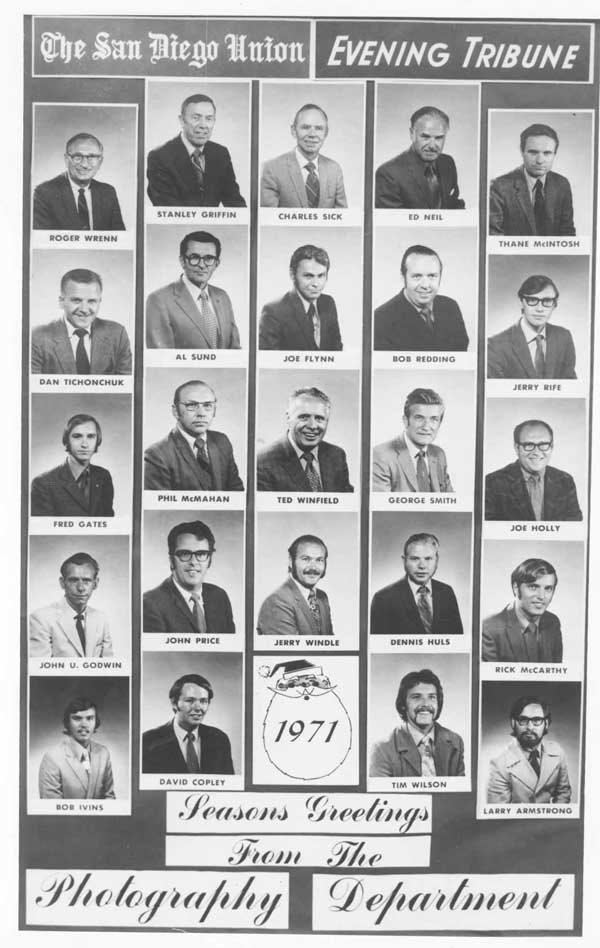
In the '60s and '70s, a quick glance at the UT staff would have given the impression that we were all cut from the same bolt of cloth. Perhaps more than anything, that impression was conveyed by a simple strip of clothing, the necktie.
Every man wore one. (And since there were few women in the newsroom, that meant nearly every person) Photographers, whether shooting a bloody corpse or a society matron, would not have been caught dead without a tie neatly tied.
At first, the neckties were dark and subdued. They gave an air of gravitas while being able to hide a gravy stain. As the decade rolled on, newsroom ties exploded in a riot of color and design. They blossomed like flowers in springtime.
But it is the nature of flowers to wither and die. So too was the tie to fall from our collective neck like some pooped pansy.
When this picture was taken in September of 1981, autumn had already arrived for the UT necktie. Like the last rose of summer, a tie-adorned Charlie Sick was faced with a changing climate. The open-collared ruffians are (l-r, in back) Don Bartletti, Barry Fitzsimmons, Phil McMahan, Joe Holly, Jerry Rife, John Gibbins and George Smith.
I forget the name of the guy fingering Charlie's tie.
But I remember so well the time when the tie died.

Note: I well remember both the ties and the outrageous "psychedelic" colors and patterns of the 70's. Sally used to find the most ridiculous material and then hand make mine, about six inches wide, pink, orange, flourescent purple... and glow-in-the-dark would have been at the top of the wish list.